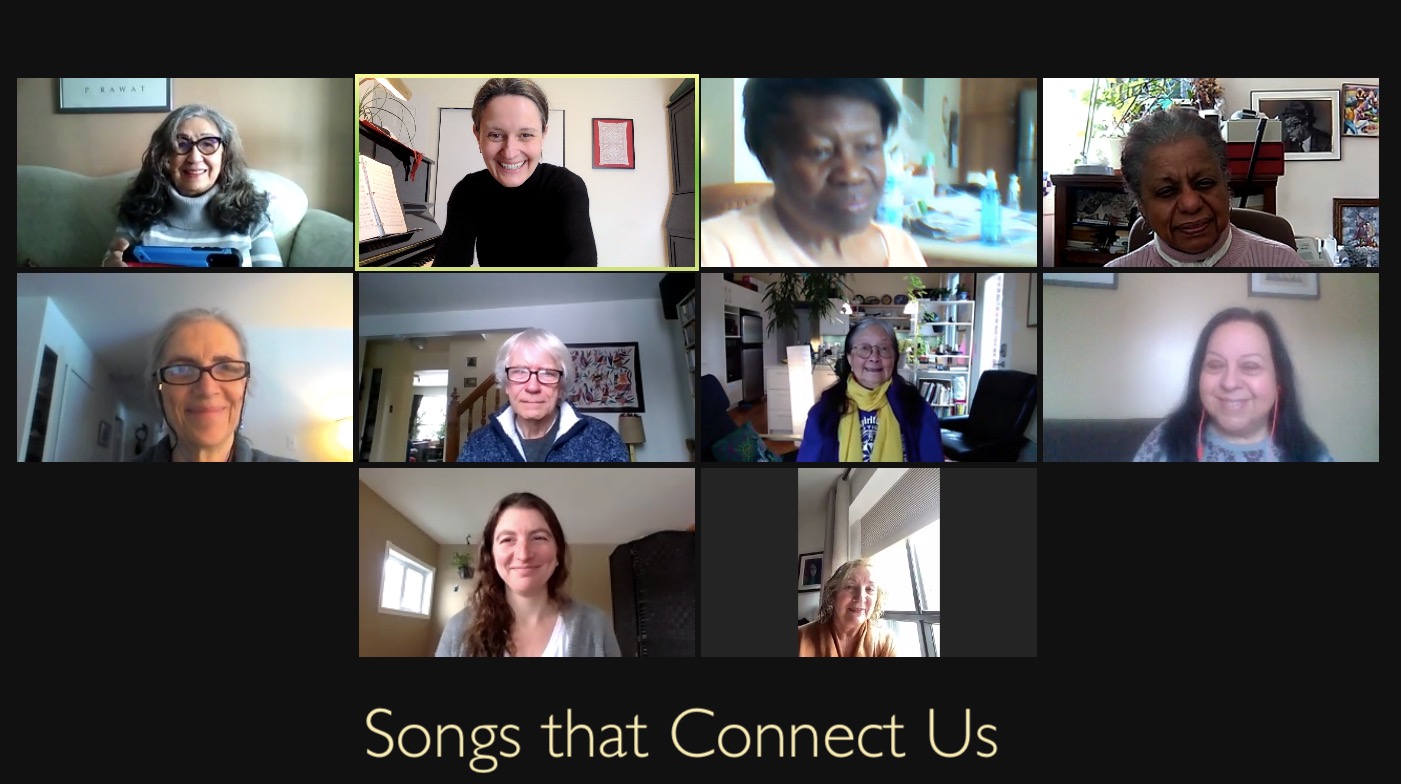
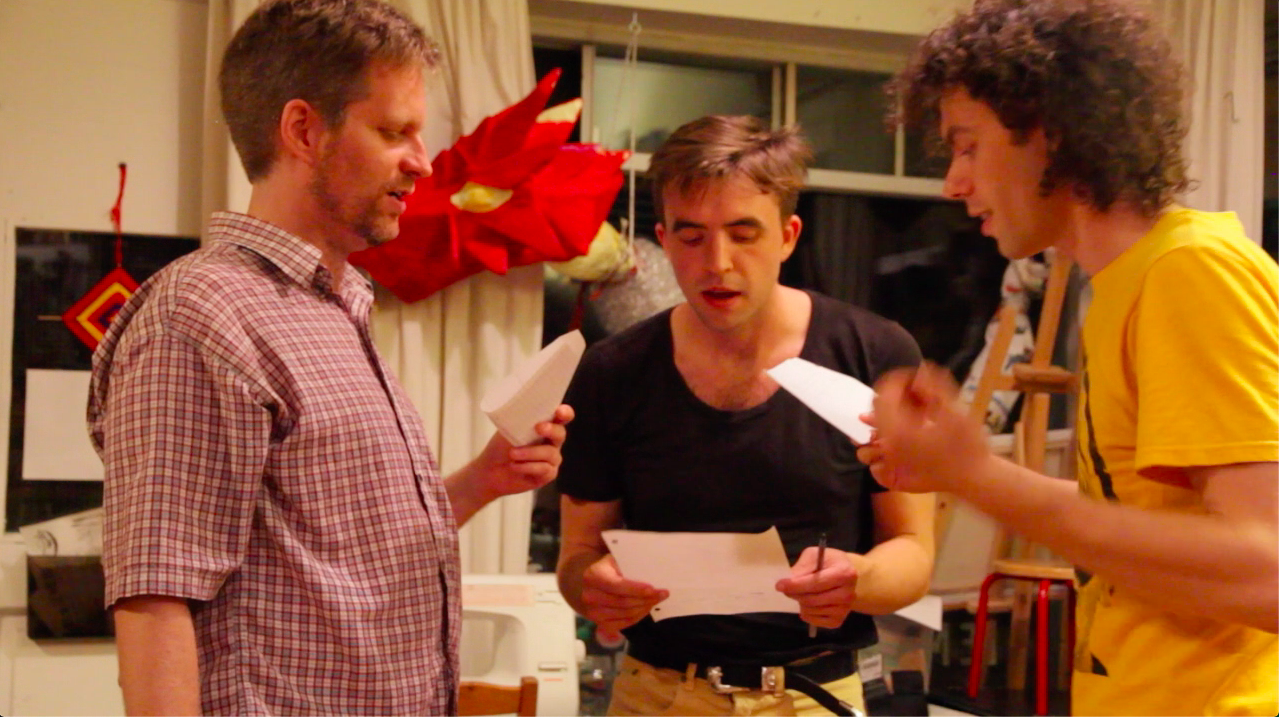
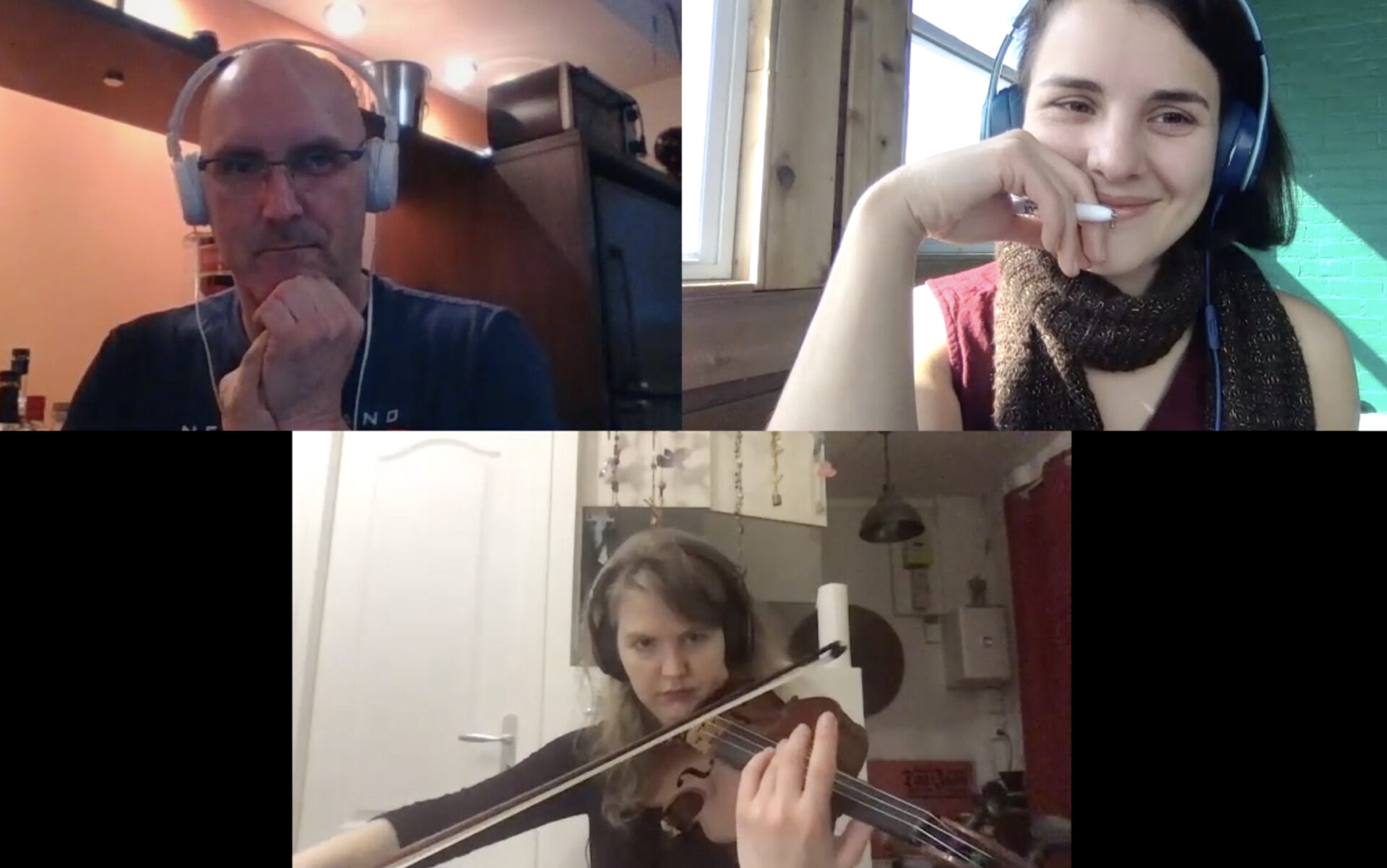
Piece of Mind uses the performing arts to synthesize and translate knowledge about Parkinson’s disease (PD) and dementia. Our participatory research-creation project brings together artists (circus performers, dancers, musicians, visual artists), researchers, individuals living with PD or dementia, and caregivers to co-create artistic works based on scientific research and lived experience. The overall goals are to :
1) facilitate knowledge creation and exchange between the seemingly disparate communities participating in the creative process and
2) create performances that can engage a wide audience on both an emotional and intellectual level, and spark meaningful conversations around PD and dementia.
We use an emergent and iterative process to identify the key themes and messages to communicate in our performances, and to ensure that multiple perspectives are incorporated along the way. Our research process has included numerous virtual workshops, facilitated discussions, and movement/music sessions to build relationships and explore both scientific and lived experience knowledge through creativity and embodiment. Rather than present a summary of the various activities we’ve undertaken, we’d like to share two examples* that could easily be applied in different contexts.
*You can find our other example here :
https://www.newmusicnetwork.ca/projects/piece-of-mind-give-us-a-hand-participatory-art-sci-video/
ACTIVITY : improvisation exercise from lived experience, to artistic representation, to scientific interpretation
GOAL : the purpose of this activity is to explore topics around Parkinson’s disease (PD) through the lens of lived experience, artistic representation, and scientific interpretation, and to facilitate mutual understanding between participants.
WHERE : via a virtual platform such as Zoom, or in person.
DURATION : 1–2 sessions ; each 1–2 hours.
PARTICIPANTS : in our project, the participants were researchers, artists (including musicians, circus performers and dancers) and people living with Parkinson’s disease. The process can easily be adapted to other target audiences.
GROUP SIZE : 3 per group : one person living with PD, one artist, one researcher. If you are working with multiple artists (ex. a musician and movement artist), you could increase the group size to 4.
INSTRUCTIONS :
1. Introduce the topic or question of interest that you would like to explore in the session. In our case, topics were used that emerged in previous sessions, including motor limitations, the invisible aspects of PD, and how PD changes one’s perception of time.
2. Process : Each person in the group has 1–2 minutes to share or present something based on the proposed topic. The person with PD begins by sharing their lived experience of the topic. The artist then responds to the experience, either directly (e.g. with voice, an instrument, movement) or by explaining how it might be represented in an artistic medium. The researcher closes the loop by providing scientific context to the experience, or new questions that come to mind from the exchange. Repeat the cycle as many times as you wish.
3. Participants are requested to keep their responses to 1–2 minutes so as to allow several cycles between lived experience, artistic representation and scientific interpretation. As the cycles progress, the process can become less defined as participants build on one another’s ideas. We use body language and improvisational games to help bridge the connection between the 3 perspectives — you can check out some examples in the attached videos.
4. If working virtually, group participants into breakout rooms. You can choose how long to make the breakout sessions ; we recommend at least 15 minutes per topic. If you would like to revisit the exchanges afterwards, don’t forget to record !
5. After the activity, have a group discussion (with all participants) to share ideas and get participant feedback. If you have time, switch groups and repeat the activity based on new questions that emerge !
DESCRIPTION OF INCLUDED VIDEOS :
1. Anne, Louise, Anusha (English)
In this video, the participants discuss how Parkinson’s disease shapes one’s perception of time, and how the rhythm of life is controlled by medication. Anne, a woman living with Parkinson’s disease, begins by explaining her experience of how time fluctuates during the day. Musician Louise Campbell invites her to participate in a musical simulation of the experience, by “conducting” her clarinet playing through hand gestures. Anne raises her hands to indicate when to play faster, lowers them to indicate slower, and Louise adds texture to the music based on Anne’s other movements. After the exchange, neuroscientist Anusha reflects upon the external cues that regulate our sense of time, and how medication might affect people differently.
Translated quote from Anne (in the group discussion afterwards): “[…] it was incredible – it was as though my brain was singing. It was really, really beautiful.”
2. Serge, Caroline, Naila (French)
In this video, Serge, a man living with Parkinson’s disease, begins by explaining the motor symptoms he experiences, and how these feel in his body. Caroline, a musician, suggests an idea as to how the symptoms Serge described could be represented on violin, and improvises a short piece. Naila, who studied the brain circuitry affected by Parkinson’s disease, ends by drawing a parallel between these motor symptoms and how PD changes the communication between neurons.
Translated quote from Serge (in group discussion): “[…] she started playing the violin, and at first I had a lot of tremors, but her music calmed me […] I managed to control my body.”
3. Serge, Caroline, Rebecca, Sherilyn (French)
This video depicts a second round of the improvisational activity, in which Serge (who has Parkinson’s disease) shares how the Piece of Mind project has affected him emotionally. The musician Caroline interprets his testimonial through rhythm and voice, while Rebecca, dancer and researcher, accompanies her with a movement improvisation. Sherilyn, a PhD student studying Parkinson’s disease, explains the emotional aspects of the disease and the corresponding brain regions that are affected.
Translated quote from Serge (following an explanation from Sherilyn): “You just described me as though you’ve known me for a long time.”
4. Anne, Louise, Claire, Anusha (English)
This video depicts a second round of improvisation between Anne, Louise, and Anusha, a few weeks following the first one (example 1). This time they are also joined by Claire, a researcher and tap dancer. In this clip, Anne, who has Parkinson’s disease, conducts Louise’s clarinet playing, using hand gestures to demonstrate how she is feeling that day. After the improvisation, Anne provides context as to how this compared to the previous session.
*Please contact Naila at pieceofmind.montreal@gmail.com if you’d like to know more about the project.*
Young Composer Program – Contemporary Showcase Edmonton
The Young Composer Program organized by the Contemporary Showcase Edmonton Society introduces students ages 12 and up to composition and assists students to develop their compositional techniques.
This annual program is held in 4 sessions :
Session #1 (Group session of 2 hours)
The composer/clinician speaks about composition in the first hour. These lectures have included anecdotal information about how the clinician became interested in composition themselves, how they approach starting a piece, where they get their ideas, etc. These sessions have also included discussions of elements of new music including analysis of scores, presentation of non-diatonic scales, and even sound walks.
The 2nd hour, held in a piano lab, gives the students a chance to start sketching ideas or doing assignments given by their clinician with the opportunity to discuss these ideas with the clinician as they begin to take shape. Clinicians have given a variety of starting assignments. These include :
Introducing a variety of non-diatonic scales (including whole tone and octatonic)
Experimenting with 12-tone rows
Writing a variation on an original theme
Creating one unit for an aleatoric box work to be performed collectively.
Creating two different triads (avoiding the standard triadic formula of stacked thirds) and developing a variety of ways to use the notes in different registers and groupings.
Creating an overall sketch for a piece by first mapping out tonal character, dynamics, registers, etc. and the approximate number of bars for each section.
After a 2 week period, the next 3 sessions are held weekly. Each student receives a half hour lesson with the clinician to discuss how to develop their ideas into a full piece. Students are encouraged to attend other students’ lessons for maximum benefit.
After the 4th session, the pieces are mostly finished. Students then have 1 to 2 weeks to polish their score and submit it to the clinician for final comments.
Final Concert
A final concert is held about 3 weeks after the last class for the students to perform their own compositions.
Students, especially at beginning stages, are encouraged to do handwritten scores to gain practice using their rudiments training.
Created Pieces from previous Young Composer Programs
Samples below include Cat and Mouse (inspired by Bridget the cat) and Evening Storm both by Jonathan Urschel – age 12 ; Waltz of the Wild by Ashley Kang – age 14 ; and MASS EXTINCTION ! by Sointu Aalto, age 16.
Jonathan’s clinician had the students experiment with 12 tone writing as an exercise. Jonathan’s Evening Storm was his completed exercise and he chose to use 12 tone elements in his main project, Cat and Mouse, also. Jonathan did not have any previous writing experience.
Ashley also had very little writing experience and Waltz of the Wild was written in her first year of the program.
Sointu has been involved in the program for at least 3 years and has chosen to study composition seriously throughout the year. The composition below, written during the 2020 program is the winner of the 2020 Louise MacPherson Memorial Ward. It embodies her rage at the number of species presently becoming extinct and the silent tam-tam represents those who stand by doing nothing to change the problem.
Have you ever wanted to create your own music/multimedia artwork, but couldn’t figure out where to begin ? While creation can seem intimidating, it can actually be surprisingly accessible, and more importantly, FUN !
The Paramorph Collective (Kim Farris-Manning and An-Laurence Higgins) has put together a series of five exercises to guide you through vocal and sound improvisation, homemade video creation and creative writing. You can use one or many of these exercises in order to help guide the creation of your own original artwork. The series also contains one brief overview on sound and video editing.
This series of exercises was originally created by composers and multimedia artists Kim and An-Laurence for a commissioned project with the virtual community choir SING THE NORTH, leading to the creation of “suddenly I was alone/d’un tratto ero sola” (2021) with 49 singers from high-school age to retirees based in Canada, the USA, the UK, Australia and Italy. Watch the final video below.
This series of exercises is meant to be used by self-directed individuals or groups. Exercise material can be used by facilitators upon request. If you wish to collaborate with Kim and An-Laurence, or hope to organize a similar project as a facilitator, please get in touch at kfm.alh@gmail.com.
Remember that the true value of improvisation lies in the process, not in the end result.
✧・゚EXERCISES ・゚✧
Links to all audio examples are listed at the bottom of this page. You will find pdfs of each exercise in the score section below.
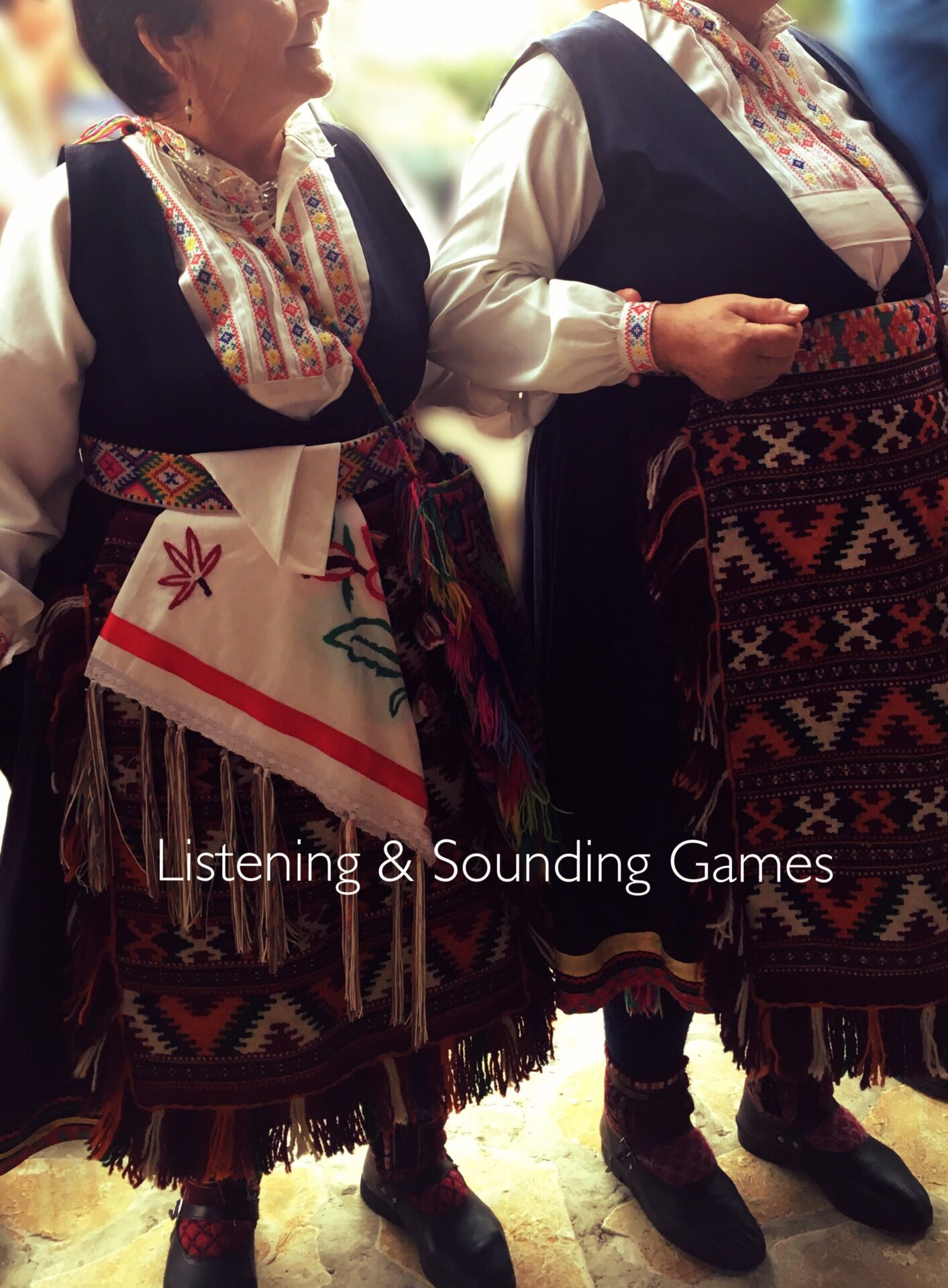
These Listening & Sounding Games are fun and easy games for two or more people and will actively engage participants in a process of deeper listening and playful sounding with the voice.
They are inspired by and adapted from theatre games, vocal improv exercises and my work in traditional Balkan singing. Like many folk singing traditions from around the world, traditional Balkan folk singing is an oral tradition ; the songs, their stories and the ways in which they are sung were passed down from one generation to the next, learned much in the same way that one first learns to speak : by listening, imitating and repeating.
I discovered that these three elements were essential to the development of musicality and presence in my singers and so it is I began implementing these games, drawing from three forms of singing found in many oral singing traditions : unison singing, the drone, and call-and-response.
These games be used in any setting – from the classroom, to the community centre, to the choir rehearsal. I have mostly used them as warm-ups, but they can easily be used as stand-alone exercises, incorporated into primary or secondary school lesson plans, or even used as springboards to new possibilities for interpretation, improvisation and performance.
The games are an excellent tool to get non-singers to sound, but they are also very effective for experienced singers who might otherwise be more accustomed to singing from notated music or lyric sheets, to go beyond the page and into their sensing bodies resulting in a more deeply felt and embodied sounding that can be carried over into their other music-makings.
Outcomes :
deeper listening
whole-body participation
heightened senses
increased awareness
ease, confidence and joy in sounding with the voice
increased musicality and presence
deepened relationships amongst group members
a greater sense of connection and ensemble
You’ll find downloadable colouring-page instructions to each game below. Print them out, colour them, and share them with your groups !
UNISON This game really gets people listening – beyond the ears. Encourage participants to use their eyes to see, their ears to hear, and their bodies to feel.
CALL AND RESPONSE This game encourages people to listen, imitate, explore the voice and gain confidence in their singing. By incorporating gesture, this game is very playful and fun for young and old alike. Variation : Use it as an ice-breaker ! Have individuals sing their name with an accompanying gesture, which the group sing and gesture back ! Up for a challenge : Have one individual sing the call, and another sing a different response. This game can easily turn into an improvised song !
SOUND WHEEL No time to think ! This game will get people out their heads and into their bodies.
HUM There are so many possibilities with this game ! Some ideas : incorporate it into a performance ; give directions for different tempi or dynamics in the walking/sounding ; have participants walk silently and hum when still ; try it without walking, sitting with eyes closed…
DRONE DUET This game is great to begin work on timbre, intonation, and listening and sounding with the whole body,
MIRROR This theatre game lends itself well to sounding with the voice. Develops listening, presence, whole-body awareness and a sense of connection. Variation : Instead of facing one another, try it with two singers seated with backs together touching. Begin by breathing together. Turn the breath into voiced sighs then into sounding.
A community-based collaboration featuring original local music paired with the stories and sounds of seniors residing in an assisted living centre
Over the course of multiple workshops, get to know participants so a bond can be formed and participants will feel open to sharing. During the workshops :
Using a hand held digital recorder, record and catalogue sound as much as possible, which will allow for many random moments that may surprisingly lead to song titles, or themes. Capture sounds unique to the individuals engaged. These sounds can be looped or pitched and used to make beats or rhythms specific to the locale, and be used to teach that ordinary sounds can be musical.
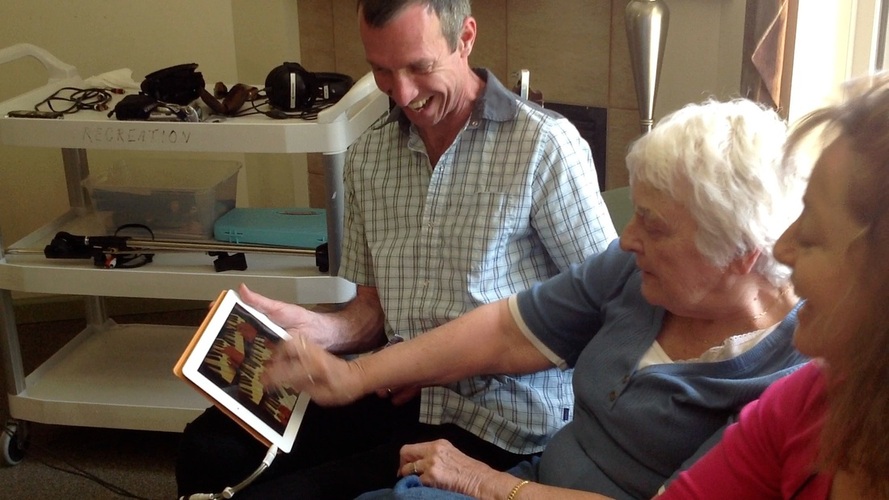
Let participants try instruments and/or music apps on devices. See Sheila and Steve sit down to create ‘Hope’ as an example of introducing someone to an instrument for the first time. For trying music apps, see Germaine steps up to the iPad for the first time. Tell participants there is “no wrong way” to touch the screen and make a sound, and that oftentimes being naive is an advantage because they will do something new. Put them at ease by casually trying it in front of them and showing them that it’s easy to do. Record these to use as segways, intros, or full tracks.
During the recording of voices for workshops, encourage conversations on themes. This will give a sense of play to the project and process and bring meaning to participants. Some examples include : “Where were you born?” “Have you ever had a nickname?” What was your favourite toy as a child?” “What’s your biggest fear?”
Be open and present to recognize a magic moment – be it group laughter or a serious story, and use that to anchor the song/piece.
Gather musicians to play a score that has been created (a number of short instrumentals or songs) or improvise music and edit pieces or moments into short clips of music (2–5 mins) that will fit well with the length of a short story. Use original recordings from participant engagement with apps in workshops to include as backdrop pieces of music. Experiment with different combinations of instruments : drums and voice, guitar and bass, full band, etc. Use the “keeping turning left” model of doing something opposite of what was just improvised : change keys, change tempo, change instruments.
Listen to the recordings of the stories and choose which musical piece would fit well, based on theme, language, mood, and length, or randomly combine workshop recordings with music.
Edit the stories if necessary, creating space between words, and treat the material as sonic or musical moments, or leave the chosen story in it’s original state and let the music and story be independent of each other, all the while being combined.
A strong idea to create meaning and flow is to edit a word or section and repeat it as you would a chorus of a song. Many times you will find sentences that have their own rhythm work well when combined with music of a different tempo and/or rhythm.
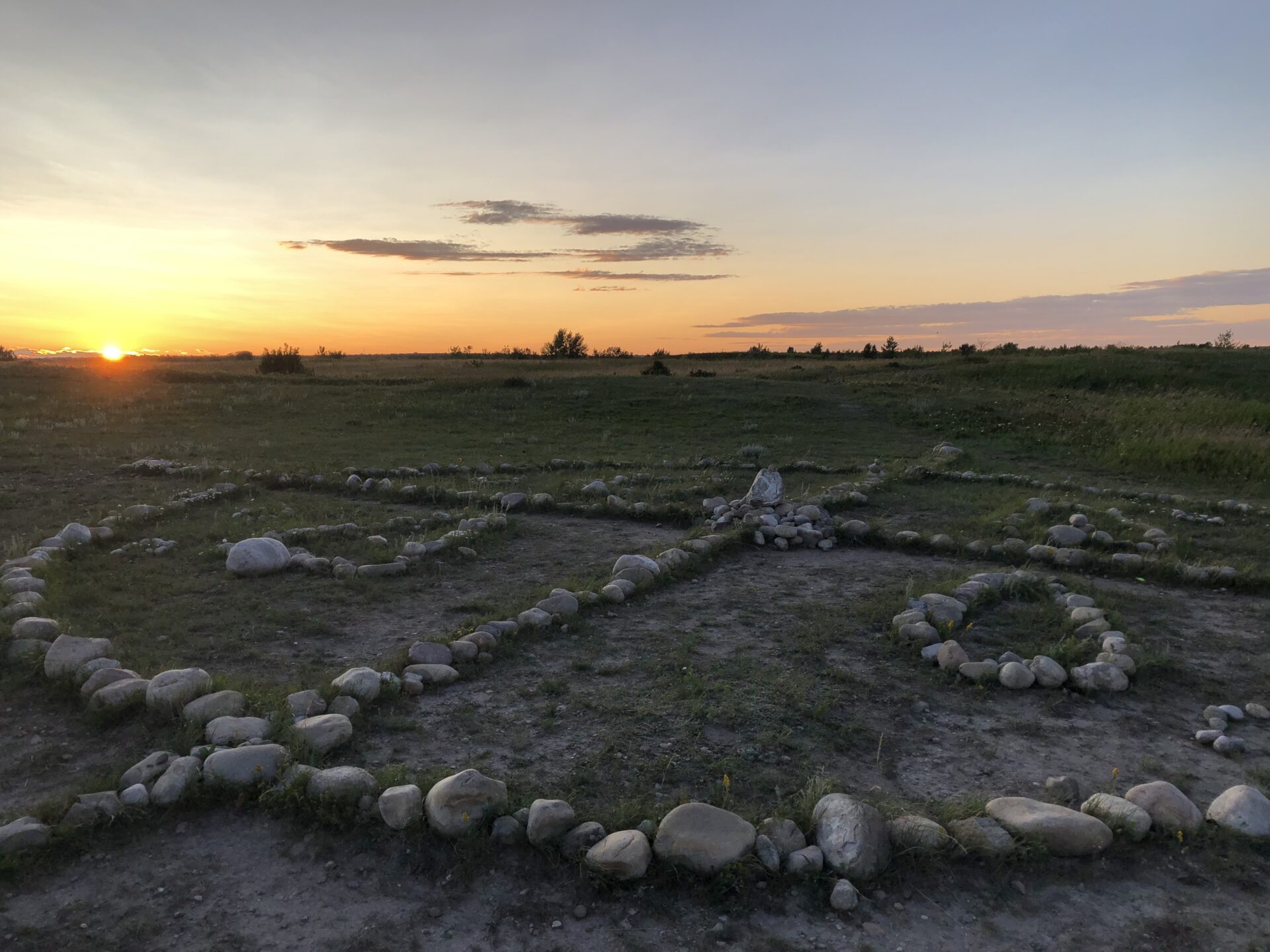
okâwîmâw askiy is Mother Earth (nêhiyawêwin/Plains Cree language), always providing for us in ways beyond our wildest imaginations. This workshop provides an opening for us to strengthen our connection to earth while activating our voices and bodies through sound and movement.
As we move through prompts based on teachings from the medicine wheel, we deepen our presence with our four bodies (mental, physical, emotional, spiritual) and the four elements (earth, fire, wind, water) and we activate our senses. We work in a circle, whether actual or perceived, in an on-going acknowledgement of our relationship to the many earth and sky relatives that are beyond our two-legged (human) realm.
Looking at concepts :
medicine wheel : in an nêhiyaw/Plains Cree perspective we all have four bodies ; physical, mental, emotional, spiritual. When we consider all four bodies in the way we vocalize and respond to the world within and around us, we can find balance through sound. We also acknowledge the four elements and the four directions as integral aspects of this balancing.
miskâsowin : finding one’s sense of belonging, locating oneself within the circle (of life). We continually work in relationship to one another where all voices matter.
wâhkôhtowin : kinships beyond our immediate family ; an acknowledgment of all of earth’s creation as members of our extended family, as relatives.
nikamotan : let us sing together as creative medicine to help us grow and strengthen our capacities for listening, mirroring and living a good life together.
nanâskomowin : gratitude. We give thanks through music and singing. In a simple way, we say “hay hay” as a way of acknowledging all the relationships that uplift, inspire and help us grow.
What place or landscape is home for you ? How do you acknowledge your body as home ?
1. Coming home through breath :
Following a simple count in a circular pattern, we explore the cycles of birth, growth, death and release. We inhale and take in the air around us, this air ignites the fire inside, warming us and filling our bodies with energy. We hold this air inside in awe, feeling into where space is being made with new breath. We release this air and we calm the waters in our bellies. We feel the emptiness of release. We repeat. Each time we cycle through breath, we engage with different images, thinking about the elements, the cycles of life, of sunrise and sunset. We use our body as a map to connect with landscapes and remember that our body is our territory. Once you are finished cycling through this breathing exercise a few times, take a minute to sit quietly and notice if there are subtle changes in your inner world. Then ask, what has shifted in your perception of your relationship to the world around you ?
What sounds, sights, smells, feelings, tastes inspire you to sing and to call into existence the sounds alive inside and around you ? We explore how our voices blend, echo and mirror the world around us and invite new sounds and languages for connection. You can work with images, sounds from nature and other found objects or memories to create the activation for call and response.
3. GRATITUDE song :
Through song we give thanks to all the beings, people, places and gifts that support our existence. Looking around and within you, we sing out, name and celebrate these gifts together.
The important thing, as one cannot repeat too often, if that the child should learn to feel music, to absorb it, to give his whole body and soul to it ; to listen to it not merely with his ear but with his whole being. ~ Emile Jaques Dalcroze
Goals :
Embodied understanding and engagement
To encourage “knowing-in-action”.
To accept and nurture movement impulses and emotional reactions to music.
To engage with the sensing, feeling, experiencing body through musical sounds and activities.
To cultivate performance, listening, reflection and creation.
To examine the body as a conscious and explicit mode of transformation.
To invite the wealth of information and knowledge that the sensual body holds and invite it into the educational musical experience.
To actively engage in imaginative, music creation at all ages and levels.
To develop musical potential through informal guidance that connects the listening experience with sound exploration.
To create a listening and responsive musical community.
By utilizing the mood meter, participants explore their inner emotional world and how that emotional world can be explained in terms of pleasant and unpleasant feelings and higher or lower energy.
These concepts are explored using the language of emotion.By tuning into this emotional experience, documenting it, and then relating it to music, participants can explore their own sound art potential.
Any instruments can be used, including found objects, the voice and/or body percussion. The music ensemble of any size and/or instrumentation is the framework.
The music created will reflect the four colours found on the mood meter (see attached photo).
Participants will create an improvised work – a collection of 4 pieces.
The facilitators participate as much or as little as necessary, based on the students brainstorming and improvisations.
The final performance consists of the students using the language of emotion and color to create an improvised musical work.
Step by Step Instructions :
Look at the Mood Meter and explain how it works.
Divide the group up into 4 ensembles.
Using large pieces of paper and coloured markers, have each group brainstorm “feeling words” around the 4 colours on the mood meter :
Blue : low energy, unpleasant
Green : low energy, pleasant
Yellow : high energy, pleasant
Red : high energy, unpleasant
Once the group has brainstormed language of emotions, they can explore “improvising emotions” on their instruments.
The group creates a suite of 4 improvised pieces based on the four colours displayed on the mood meter.
Extensions :
Brainstorm contrasting musical terms that coincide with emotions and corresponding musical responses (ex. staccato, legato, forte, piano, dissonance, consonance, timbre, etc.)
Use photography, video or visual art found through online research to mirror the emotion as a way to further enhance the sensual exploration.
The visual art work or poetic responses could be created by the students.
Listen to instrumental music from a variety of styles and have the students identify the “colours” or “moods.” The students can think in terms of high or low vibration, pleasant or unpleasant feelings, and the language of emotion.
Use music notation, lead sheet construction and/or graphic scores to document the composition.
My Personal Reflection :
I first taught this unit when I was the artist-in-residence at my son’s Reggio Emilia based elementary school in Coquitlam, B.C.
As a school, they were responding to the Mood Meter as a daily check in. Over the weeks, I watched my son learn about how to describe his mood. His vocabulary expanded and he became very comfortable articulating his feelings at a very young age. I was excited to see this work happening with young children and I quickly realized that this vocabulary was a wonderful gateway into aesthetics in music. I looked to develop a musical activity that would draw from the socio-emotional learning that was already happening in the classroom .
Music is the language of emotion and when young children develop the language to describe their inner worlds, they also develop the language to describe music and then, in turn, create musical work in response to those concepts.
Over the years I have used this activity with groups of all ages and abilities.I am always amazed at the unique ways the participants were able to engage with the mood meter, relate their findings to describing recorded music and then create beautiful, improvised music compositions.
Listening Games for Reducing Noise Levels in a School Cafeteria
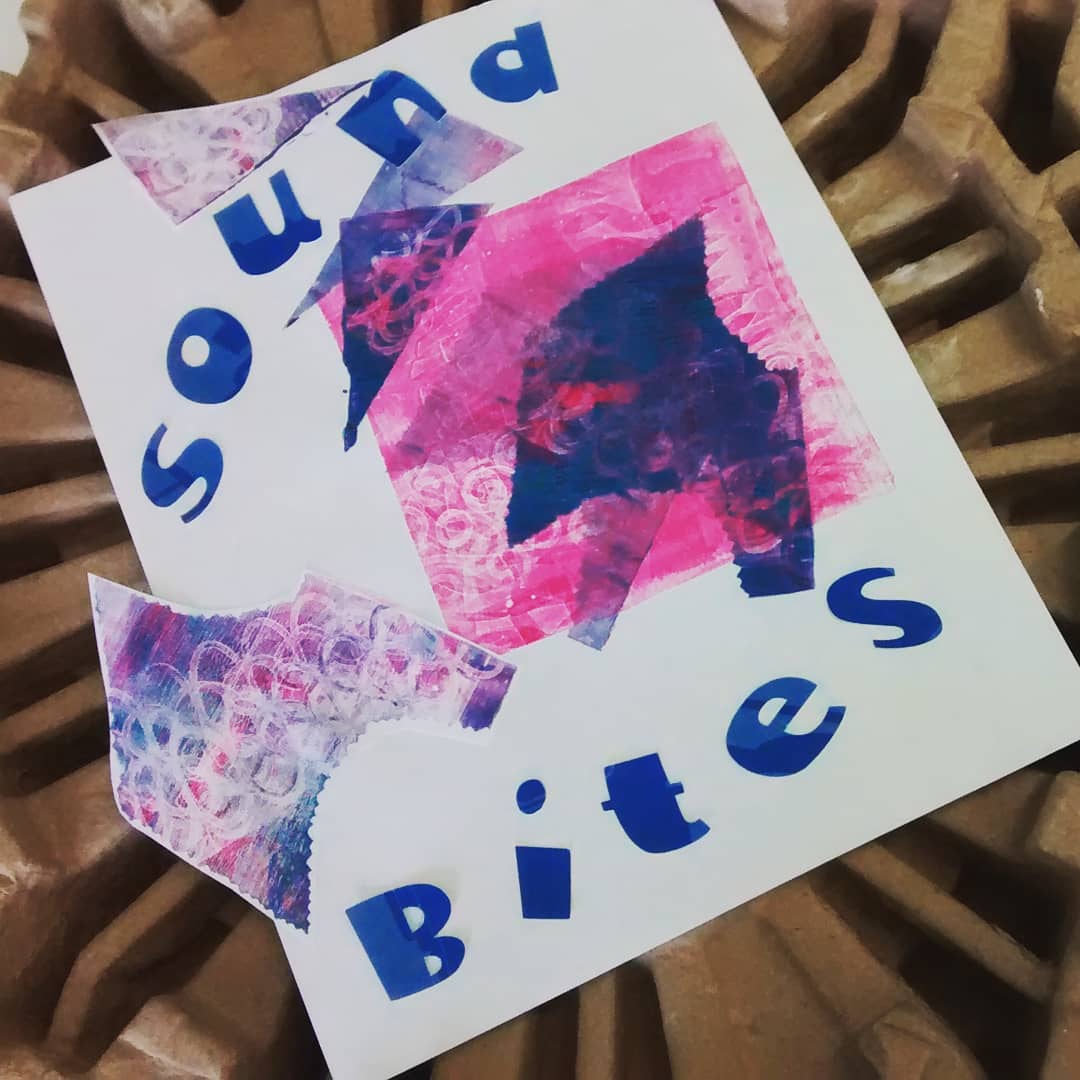
Picture a large room : concrete floor, low tile ceiling, bare plaster walls, tables lined with stools, a wall of industrial fridges and an attached commercial kitchen. Imagine the accompanying sounds : hums, buzzes and the metallic clanks of a busy kitchen. Now imagine the same room filled with 100 or so kids eating lunch, anticipating going outside to play. The enthusiasm and efficiency of this room are laudable ; the sound levels impressive. I had the pleasure of being an Artist in Residence for Sound Bites, a School Hosts an Artist project aimed at reducing the noise level in this room, Coronation Elementary School’s cafeteria.
A school cafeteria is similar to a restaurant or a bar – there are a lot of people in an enclosed space, usually with a fair amount of background music and/or noise. People talk loudly so they can be heard by their friends, which means other people talk louder in turn. In brainstorming with science teacher and visual artist Shelly Sharp, we came up with the following focus questions :
“How does sound affect our well-being ? What can we do as artists, students and adults to understand and positively impact sound quality and volume in the Coronation Elementary lunchroom?”
In order to have an effect on noise levels in any space, you start by listening. So if the project Sound Bites aims to reduce the noise levels in the Coronation Elementary School cafeteria, we needed to make listening fun and engaging for the students. The following games aimed to do just that.
Ready… set… listen !
Sound Treasure Hunt
Before playing the sound treasure hunt, ask students to name any sound they hear (e.g. a sneeze, a car horn honking, shuffling feet).
Ask students to identify a sound they hear frequently in this room, and not say it out loud. Pick one student to ‘play’ the sound while everyone else covers their eyes (e.g. eraser on whiteboard, chair scraping, percussion mallets clacking against each other). Ask for volunteers to guess what the sound was.
Ready… set… listen : Over a two-minute period, sit quietly and listen. Then, ask students to write or draw the sounds they heard. If they have trouble remembering what they heard previously (I do!), they can write or draw any sounds they are currently hearing. Ask volunteers to read their list or describe what they heard. Notice the similarities and differences in what students hear.
Tips :
Use a visual aid to show where you are in the two minutes period to avoid the inevitable question ‘how much longer?’
Adapt the length of time to your group. I prefer several listening periods of shorter time frames so the treasure hunt is different every time. Given how much how quickly sound changes in an elementary school, one two-minute treasure hunt could feature the janitor walking down the hallway with a trolley, greeting a few kids, while the next might be about the sounds of the heating system starting (reluctantly), and the next basketball practice in the gym down the hallway.
Brainstorm a number of distinct acoustic environments to listen to that are within easy walking distance. Repeat the treasure hunt in each location, writing and drawing the sounds of each. Discuss, comparing locations.
For Sound Bites, we chose to listen to a stairwell, the library, and two different locations in the cafeteria.
The kids floored me with their enthusiasm and acute ears. As you can see in the images below, their responses are amazing, complex and varied, and say as much about each individual as it does about their school.
Finding Folk for Music is a way to share concepts and strategies for a kind of experimental folk music. The series engages people in hands-on creation regardless of anyone’s level of previous musical experience. Workshops provide an opportunity for improvisation, exploration, sound making, and audio recording in response to the environment. They are a chance to practice deep listening, a philosophy and approach to music and sound developed by composer Pauline Oliveros. Deep listening helps us understand and perceive ourselves in the world, and whether through environmental, social, or political impacts, our soundscape is always in a state of change. Documenting sound is an important aspect of Finding Folk for Music. The workshop and performance recordings are like transcriptions of the acoustic spaces and the participants’ musical engagement. The recordings have archival and documentation value, and I find them pleasant to listen to. Through these workshops I am finding new strategies to bring people together to make experimental music, and in this way, the series is an extension of my composition and sound art practice.
In October of 2019 I was invited to present Finding Folk for Music at the Sounds Like Festival in Saskatoon. The two-hour session involved eight people and explored transcription and composition strategies with a variable set of instruments. The sample workshop strategy found below this text was used for one of the activities.
It is interesting to hear the different results from the two groups who were following the same set of instructions and listening to the same looping audio sample, and to note how quickly the participants found a shared musicality in their playing.
One year earlier in Reading, UK, I had an opportunity to present a longer-form version of Finding Folk for Music, as a four-day workshop with an ad hoc ensemble leading to public performance.
Over the four days, our group explored field recording, transcription, and improvisation, with the goal of making music that complimented and responded to the environment. We went into wooded areas near campus and listened to the trees, city noises, and Heathrow air traffic above us. With an array of microphones and instruments in our hands, we set up in isolated as well as busy public spaces, making music that transcribed and complimented the soundscape. In the quietest places, we found a world of sound already present, and for the performance at the museum, the large audience and their chatter, clinking glasses, and shuffling feet became another soundscape to which we responded. Throughout the process, we asked ourselves the questions : Is there already enough to listen to ? Why am I adding another sound ? When I do, how can it be already part of the soundscape or how can it stand out through intention, repetition, or expression ?
On the first day of the workshop, participants borrowed portable recording units and set out to monitor and record the most quiet places they could find on campus.
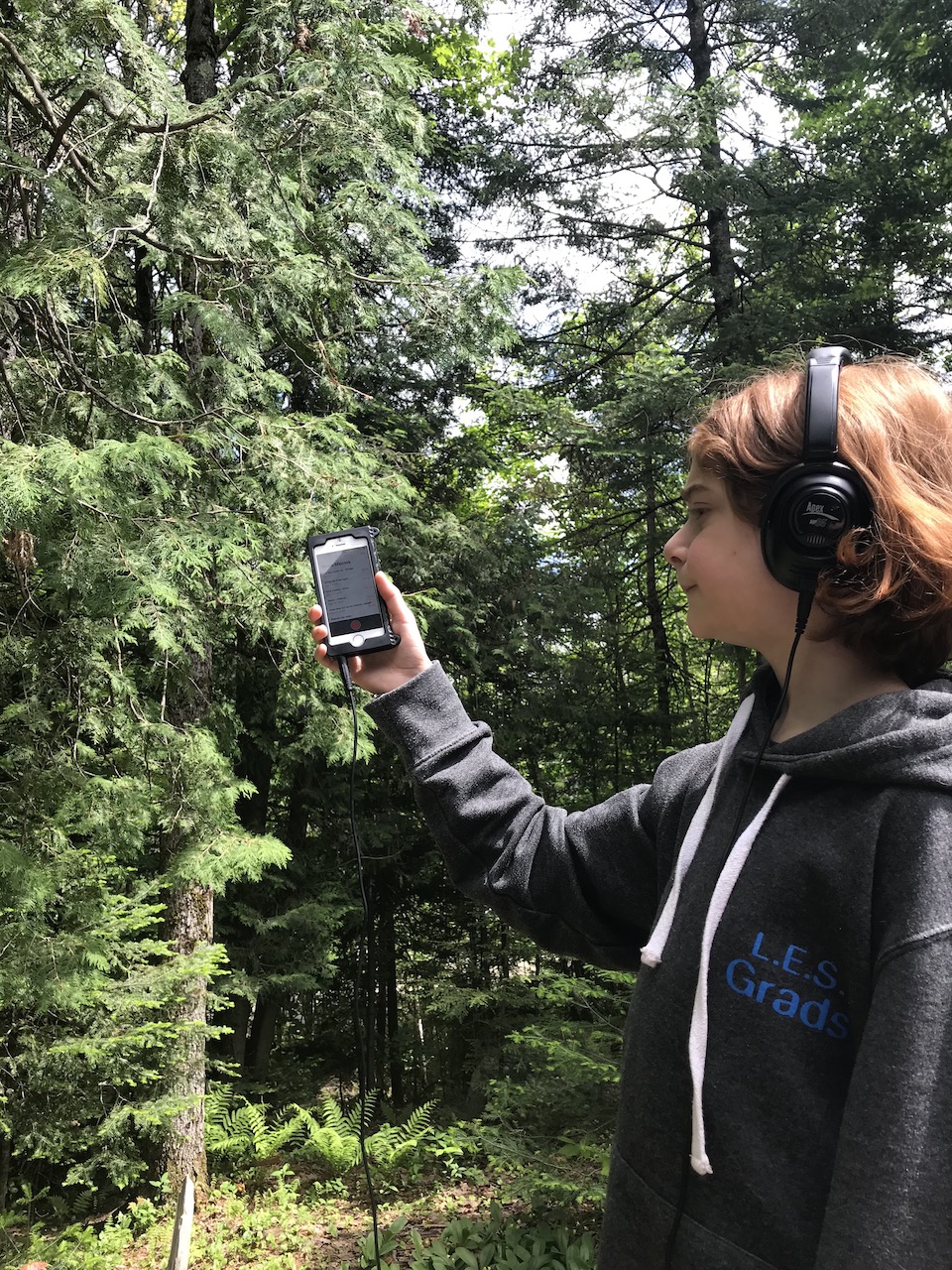
As a strategy to encourage deep listening, the field recording exercise contributed to the creative process. When making field recordings, participants wore headphones and experienced the soundscape in a close-up and immersive way, hearing the smallest details and encountering the background noise in even the quietest places. This awareness of the soundscape informed the group’s ability to improvise together, and parts of the field recordings were integrated into the performance.
Our performance was well-received, with hundreds of people standing, sitting, and walking through the museum to listen. Audience members commented on the focused and immersive quality of the music we played, and afterwards group members were interviewed about their experience in the workshop :
“The sound is supposed to react to the environment but not overpower it. We also recorded some silence and played along with those recordings. It feels very calm in our corner ; the exhibition is very hectic otherwise.”
“I learned about sound composition, how to use instruments in different ways, creating sounds with recordings from nature.”
“We were working with sounds, with different ways to record sound, to document it. It was a group project, four of us and Jeff as well. We were all there, working together during the workshops, making individual recordings, and putting it all together.”
Following the workshop and performance in Reading, I had an opportunity to present a stand-alone version of the field recording exercise in Winnipeg, on a very cold day in March in the office space of Creative Manitoba.
Participants were given a set of instructions during a short 20-minute session :
(1) Borrow a sound recorder and toy xylophone ; (2) as a solitary activity, move through the building to find a silent or near-silent space ; (3) record the soundscape ; (4) speak quietly and describe where you are and what you hear ; (5) make sounds with the xylophone ; (6) after a few minutes, stop and return.
This exercise invited participants to listen to the acoustic environment, and to hear themselves and their actions in relation to the sound that was already there. The hallways and stairwells were filled with ambient office background noise, with machines humming and the sound of icy wind outside. The xylophones interjected a playful element and a kind of sound impulse that acoustically mapped the spaces through echo and reverberation.
Later the same year, I had a chance to present Finding Folk for Music at the Regina Public Library. As in earlier presentations, the workshop included field recording exercises, group improvisation, and deep listening. We found sounds in and around the building, and we used these recordings as bed tracks and as a kind of acoustic score. Playing in the open area of the library beside a rumbling escalator and with sounds of people all around us, we responded to the soundscape, imitating what we heard, mixing background and foreground.
Through all of the presentations of Finding Folk for Music, the series has grown and has been adapted for different contexts. I have learned more about ways that deep listening, creative music making, improvisation, and composition can be engaged with by people with any level of musical training or experience. Results vary, and while I am moved by all the music we have made, appreciating this is a matter of taste. The process, however, is most important, and the strategies I am working with playfully reveal musical relationships, artistic choices, and collective efforts by people in the creation of a work of art. For me that’s the point of Finding Folk for Music.
* * *
Jeff Morton is a composer, musician, and media artist based in rural southeast Saskatchewan.
Catalyst is an online, music improvisation learning experience. Along with three instructional videos, this guide will outline some of the key components of musical improvisation. This video series draws from the Creative Ability Development method and music pedagogy created by Alice Kanack.
Along with three interactive videos, this accompanying video guide can be used by individuals or small groups of a wide age range and musical ability.
These instructional videos are designed to work in conjunction with an educator/workshop facilitator as a supporting activity, or stand alone for individual use.
What is Creative Ability Development ?
Creative Ability Development (CAD) is a method created by Alice Kanack where students use musical improvisation as a mean to develop the creative side of the brain. The main goal of CAD is to teach unique self expression or musicality. When students engage in improvisation, there are three rules or intentions we abide by :
1. There Is No Such Thing As A Mistake
”Creativity Is About Making Choices”
Our first, and perhaps our most important rule, helps students to free themselves into embracing their own creativity in choosing sounds. Composing is making decisions with sound ; improvisation is making those decisions in real time and executing them in the moment. Allowing ourselves to freely make musical decisions without worrying if they are right or wrong leads us on a journey to crafting a musical language that resonates with who we are.
2. Silence and Applause
Practicing Respect and Communication
Silence : Someone once told me that growing in our craft as musicians is centred around the art of listening. By actively listening to the music being created around us we are growing in our musical understanding and aptitude.
Applause : When we hear someone call out “Bravo ! or Brava!” after a magnificent performance, it was not originally used to just celebrate virtuosity. When the word was first used in ancient Greece, it was used to recognize the bravery of a performer. When we applause, it may not always take place in the literal sense, but through our expressions, minds and our hearts we honour the musical experience we are hearing.
3. Never Criticize A Friend
”Because there is no such thing as a mistake”
Judging a masterpiece before it is completed is a silly idea–improvisation is a life-long journey ! When we engage in improvisation we are taking part in a revolving feedback loop:We make a decision and create a sound. We hear the sound, make another decision, and the process continues… To show respect for each other’s creative journey and process, we refrain from judging someone else’s musical choices. This keeps the feedback loop clear, and fosters an encouraging supportive community for everyone to explore their creative voices.
Improvising and creating soundscapes with a loop pedal
Loop Pedal Devices & Apps :
Boss Loop Station RC-20
Boss Loop Station RC-30
Boss Loop Station RC-300
Vox VDL‑1 dynamic looper
Super-Looper App
Loopy App
Creating soundscapes : A Framework For Creating A Soundscape With A Looping Device
Start With The Root : Set the tempo, character and feel of your soundscape and showcase the key (this can be done by using arpeggios and other scale notes)
Build It Out : Holding long tones can help create a wash of sound and help participants to get comfortable by blending their sound into the texture.
Add Some Texture : Create a harmony or counter melody, Change the type of bow stroke you are using (for example : pizzicato, tremmello etc.)
Leave Room For ‘Play’ : Rests are part of the music, Feel free to leave some open space within the soundscape and let your melodies, breath.
About Kathryn Patricia Cobbler :
Loop pedal violist, composer, and arranger Kathryn Patricia Cobbler has crafted a singular niche in improvisation, and classical performance. She obsesses over creating uniquely arresting soundscapes, whether in solo recitals, composing for theatre, performing in site specific art installations, and more.
As an educator, Ms. Cobbler is a Creative Ability and Development method teacher and teacher-trainer. She continually seeks to expand repertoire for solo viola and loop pedal, and has engaged with the 9th Hour Theatre as a composer and performer for their production of Halo. She has also been known to collaborate with other composers, including a premiere of a piece by the Canadian cellist and composer Raphael Weinroth-Browne.
Kathryn Patricia holds degrees in viola performance from Western University (B.M.) and the University of Ottawa (M.M.). She performs on a viola by luthier, Sibylle Ruppert and a Boss RC-30 loop pedal.
From finding objects around the house (the recycling and ‘junk drawer’ are treasure troves!) to turning them into musical instruments and decorating them, to composing a symphony, to conducting the final performance ! Kids will find a huge amount of joy in leading this activity, stretching their imaginations, turning up their ears, and exploring their sound art potential. The instruments can be any sound making objects the imagination finds potential in. The symphony is a framework : a storyline with a beginning, middle, and end, depicted in a graphic score. The children will create the work and adults simply facilitate as much or as little as is necessary, based on the child/children. The final performance consists of the child/children using basic hand signals, cue cards, or words to cue the orchestra of musicians premiering the Stay at Home Symphony on their newly minted ‘found object’ instruments.
Step by Step Instructions :
Take a look around your home for random items you think might easily be transformed into sound making machines. Toilet paper tubes, tinfoil take out containers, old keys, dry macaroni, and empty egg cartons are some of the things we’ve collected.
Pull out your art supplies and get crafty ! Try attaching objects together to create new instruments. You might also attach string to hang the instrument or make a handle out of tape to hold the instrument. Imagine how you might drum on something, blow through something, strum something…what cool sounds can your found objects make ? Perhaps you hook elastic bands onto nails to create something you can strum, cut or, alternately, glue tubes together to create different sounding ‘horns,’ or dangle old keys or tinfoil take-away containers from strings to create chimes or cymbals. Anything goes ! Once you’ve adapted your instruments into sound making machines, you can decorate them however you like ; with paint, sparkles, stickers, string, you name it ! The more colourful, the better.
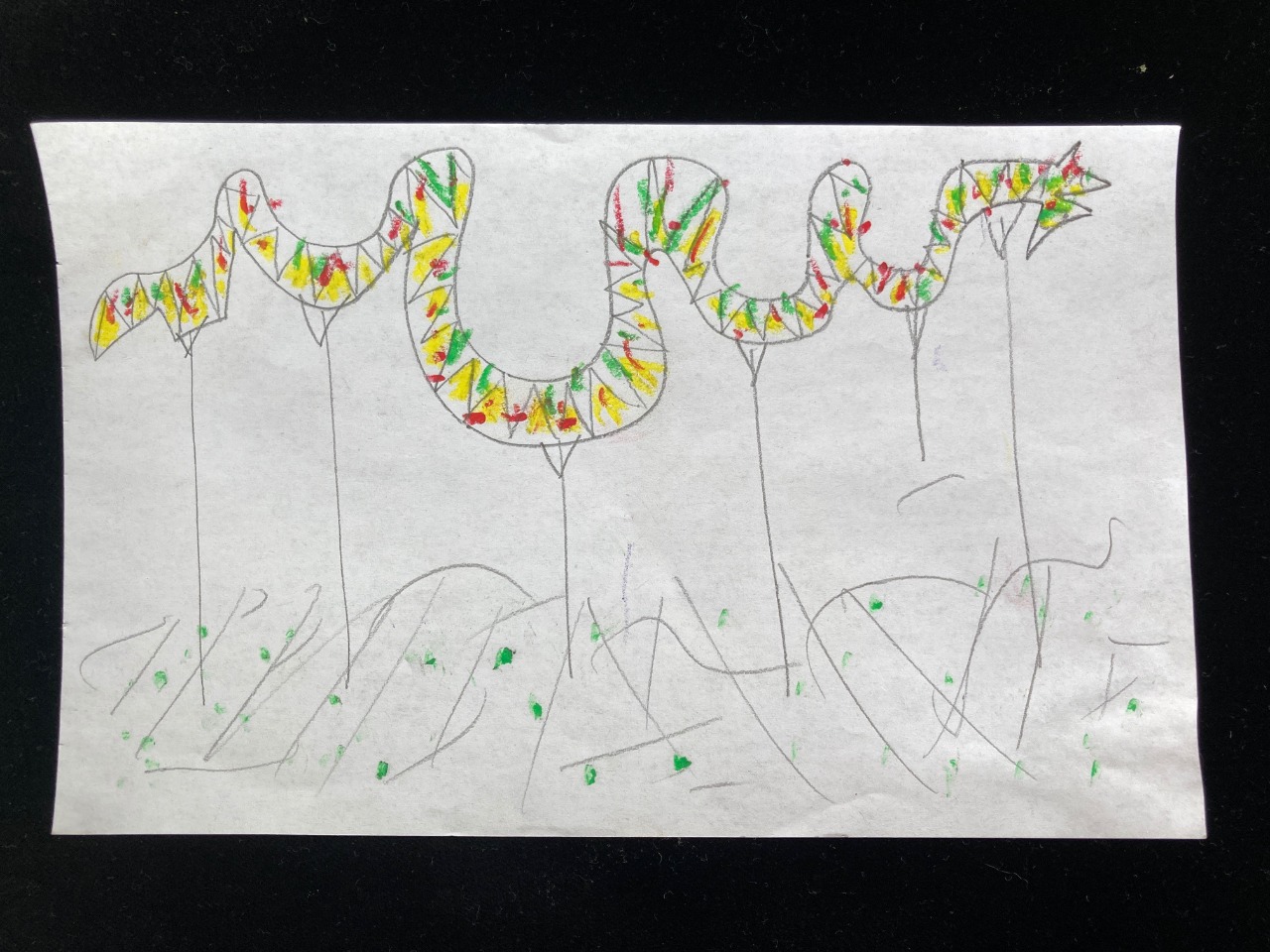
Next, you’ll need some coloured pencils and a big piece of paper to compose your graphic score. For this step, imagine the sounds you’d like to hear and what drawings might match up with those sounds. I’ve included some examples below. You might give each found object instrument that you’ve created its own colour on the score, so that when the player of that instrument sees their colour, they know it’s their turn to play. Or, you might draw a bunch of different shapes that can be interpreted by the musicians in your Stay at Home Symphony as sounds. A lot of dots or short lines might mean really percussive staccato (short) sounds on the instruments. Swirly circles or long lines might mean more connected sounds. You can use height in your drawing, too. High sounds could be indicated with markings higher up on the page and low sounds could be low on the page. Different colours could be used to tell the players what kinds of sounds to play. Or, you could simply draw an idea of what you want to hear and use hand signals to point to the musician you want to play and how you want them to make their instrument sound in that moment.
Lastly, set up a space for your big concert ! You’ll need at least one person to play your instruments, but, preferably, you’ll gather your family or friends together and have one person playing each instrument. You’ll be the conductor !
A Personal Experience :
I first taught this Found Objects Orchestra and Conduction project to a day camp of preschool aged children at a music school where I used to work teaching mostly violin. I drew from my experience as an improvisor, my knowledge of graphic score composition, and my brief introduction to John Zorn’s composition, Cobra, which utilizes a system of conduction hand symbols and cue cards. All of these things mixed with the playfulness, zeal, and chaos that any room full of preschoolers will bring came together to create a magical performance built from the ground up, cooperatively, by the children themselves. In the end, our classroom resembled a fantastical scene akin to something out of a Dr. Zeuss book, with colourful homemade instruments hanging from the ceiling, stretched from wall to wall, and balanced on chairs. The performers were assigned an initial station equipped with an instrument to make sound with and then each child rotated through the stations and took turns at the conductor’s “podium.” When at the helm, so to speak, the conductor could use any means of communication they wanted to convey the sounds they desired from the performers. All in all, we had a blast making improvised music in the moment and exercising our creative minds. The children gained so much from the experience and came away from their final performance glowing with excitement and a sense of accomplishment as a group.
A co creation project with adults faced with mental deficiency and autism issues through the reinvention of Carmen. With workshops on opera, meeting with creators, and trainers helping them producing it as well.
For many years, Opéra de Montréal has offered inclusive community-engaged activities with the objective of initiating underrepresented and underprivileged publics to opera. Several co-creation projects have been led, such as YO’péra for mental health, in collaboration with Espace Transition (CHU Saint-Justine) and La Gang à Rambrou for this with intellectual disabilities. In collaboration with the Conseil des arts de Montréal, Pierre Vachon, our Director for Community Engagement and Education, has developed in collaboration four videos explaining the principal stages of a project in partnership with non artistic organizations and with groups that are under-represented.
Capsule #1 : How to find and partner with organizations
Understanding the mission and objectives of the artistic organization
Identifying an organization with whom to build a partnership
Initiating contact
Exploratory meetings : understanding the values and social factors for the organization and potential collaborations
Capsule #2 : Defining the project
After identifying the organization you want to work with, it is the moment to determine the nature of the project. Pierre Vachon, Director of Community Engagement and Education at the Opéra de Montréal, and Suzanne Beaulieu, Director of La Gang à Rambrou, explain the foundational premises of their collaboration.
Ideation : the project
Roles : artistic team, facilitators, and participants
Now is the time to take action and establish timelines, plan workshops, let your creativity take wings, write the plot, in brief, put the project together !
Capsule #4 : An deceivingly simple but essential step : Evaluating impact !
You will want to collect observations from participants, partner organization and members of the public. Often, we deal with this information quantitatively. It’s also important to evaluate the effects on participants’ personal development. Discover how La Gang à Rambrou and their team has led this stage of the project.
Here is an approach to collaborative music making based on using existing repertoire, where a group samples and repurposes material and ideas for use as a Starting Point.
A. PREPARATION – Choose the Feature
Prepare by choosing one or more features directly related to the repertoire composition and intended to use as a Starting Point. You can also do this with the class, depending on the “depth of engagement”.
Examples :
Musical Building Blocks
Meters (odd meters of various traditional music)
Rhythmic patterns (focus on syncopation, genre-specific beats)
Cadences (traditional and as a broader concept)
Conceptual
Cross-disciplinary (Debussy’s La Mer inspired by Hokusai)
Inspiration from nature (Beethoven Symphony No 6)
Contemporary sampling techniques
Socio-historical context and other knowledges
Indigenous knowledge
Origins of African (percussion) instruments in the Americas (various contemporary jazz and latinx composers)
Interinfluence of Asian and European music traditions (multiple composers/pieces)
B. The Workshop(s)
1. Warm-up
Warm-ups are intended to bring a group into an optimal psycho-emotional state for creating music together. I like to run completely unfamiliar activities which “reset” the students’ usual band room mindset. When designing the warm-up, keep in mind the chosen Feature.
Examples :
For complex rhythmic patterns, warm-up by running some simple clapping riffs with phasing effect (3/4 4/4 5/4 starting together)
Fun physical ice-breaker activity with some space for improvisation, guided towards the Feature
2. Engage with the Feature
The Facilitator can be creative with the manner of presenting the Feature. For the students, this experience should be slightly challenging, a stretch into the “less known”.
Examples :
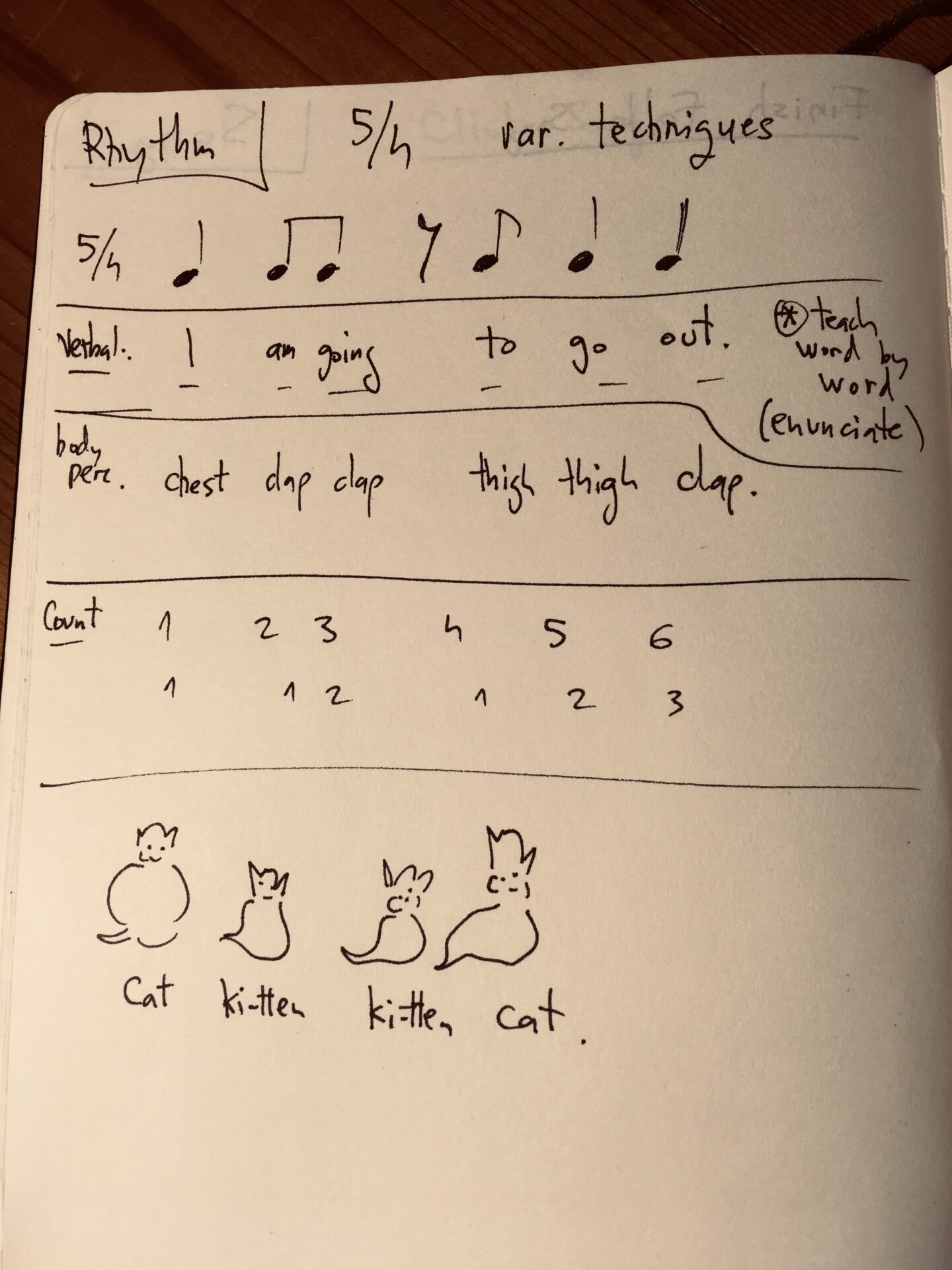
Verbalization of an odd meter (do-you wa-nna ba-na-na = 7/8)
Graphic notation of complex rhythms
Learn melody/riff/motif (lateral rote, deconstruction of building blocks, etc)
Fast visual brainstorm of concepts on whiteboard and identify/discuss connections
3. Generate Material in Break-out Groups
Assign smaller groups and give them a task for exploration and experimentation, based on the Feature (and its parts).
Suggestions :
Define clear deliverables and keep a tight deadline (<20 min)
Walk around and offer artistic assistance (listening, curiosity, appreciation)
Suggest ways a stuck group could move forward
Provide some socio-emotional guidance for resolving conflicts, assuring students that unused ideas are valuable and can be used in another context, etc
4. Share – Discuss – Combine
The breakout groups share the musical material they came up with. After some discussion, the idea is to try putting things together.
Suggestions :
Listening groups pay attention to details and make connections with their own music material
The Facilitator can get the ball rolling by directing the mix/match process
The Facilitator can suggest/direct variations in tempo, dynamics, octaves, extending/shortening bits
Rather than verbally discussing what parts may or may not fit together, have the groups try out their ideas and listen to how they respond
*For more musical material, repeat steps 3 and 4
5. Rehearse – Perform/Record
You know what to do !
Suggestions :
Students’ self-esteem from creating an original composition results in deeper focus – praise them for it !
Ask students which sections need fixing
Assign conductors for specific sections and transitions
Limit the number of run-throughs before performance. Avoid ear/mind/soul fatigue !
6. Debrief – Appreciate – Celebrate
Students can share something positive they’ve observed about one or more of their collaborators. Ask them to be specific !
If you have time, run some fun celebratory games !
GENERAL SUGGESTIONS :
Be ALERT and FLEXIBLE : students will unexpectedly come up with new ideas, which often redirect the workshop. Let go of your initial plan and follow the music !
Consider adjusting the “depth” of engagement to your students’ experience/skillset (also in real-time, during the workshops!)
Think about making this an aural experience. If notation is necessary, you can get students to create graphic notation or other alternative (student-created sculptures).
Arrange the chairs into a large circle
Please consider the ideas in this document as just a few from an infinite number of possibilities. In the spirit of this approach, this document can be chopped up and rearranged. Please feel free to be as creative as you like with these ideas !
Case Study :
Educational outreach for Saariaho Festival, organized my New European Ensemble
the project involved music classes from three different schools (International School in The Hague, Deutsche Internationale Schule Den Haag, Haags Montessori Lyceum)
each class had a different lead facilitator and different approach
the Starting Point was Kaija Saariaho’s composition Lichtbogen (Northern Lights)
the Deutsche Schule class focused on researching and discussing the natural phenomenon, and then created soundscapes based on timbre experimentation with their instruments. They then discovered notes/scales/patterns which they superimposed on the soundscapes.
the final compositions were presented as a pre-show performance during the main Festival
The beat or pulse could be considered the foundation of what we do, as music-makers. It is often the structure within which we tell a story through melody, rhythm, timbre, dynamics and even lyrics. As a music therapist, I have been witnessing the power of the beat in the form of heartbeat recordings. I work in an acute care setting, with both palliative and paediatric patients. Heartbeat recordings were introduced to me by work colleagues who had come across the work of Louisville music therapist Brian Schreck. Brian’s work with individuals with cancer focuses on the process of recording individual’s heartbeats, and composing a song to companion that recording. The resulting process and product is one that emphasizes creativity, beauty and legacy. In the work that I do, heartbeat recordings are used in work with patients, young and old, as a form of legacy for those whose diagnosis may be life-limiting.
Materials : ipad or recording device, stethoscope, lapel mic
These materials are not prohibitively expensive, as iPads are common tools, and the other supplies (Rode lapel mic and stethoscope) total ~$350.00. Other individuals have success in using digital stethoscopes like the Eko Core which may have a steeper learning curve, but is roughly the same price, with some compatible smart tools (app, etc) that make it equally easy to use.
Considerations : When doing a heartbeat recording, it is important to determine the best place on the chest in order to capture the strongest sound of the beat. There are lots of great resources online that provide a good overview, along with diagrams that give an idea of placement.
When using equipment that is sensitive, it is good to try to have as quiet of an environment as possible – to put a sign on the door indicating that a recording is in process, etc.
It is important to put the individual at ease, as they may be uncertain about a new experience, even when feeling positive about making the recording. Many people with health challenges often have changes to their bodies that can make them feel self-conscious. This can be done by easy conversation leading up to the recording, by warming the stethoscope, etc.
There are other considerations that may make it difficult to obtain a clear recording. If someone’s heartbeat is very weak, it may be challenging to get a recording that sounds like a heartbeat. This is also the case with individuals who have experienced extreme weight loss due to disease. The most important thing would be to be able to have a pressure-free time of trying to find a clear heartbeat that will determine whether proceeding with a recording is a good idea.
Consent : It is important to have consent for the process and the recording, whether it be for art, research, treatment/therapy, etc. Ensuring that the individual clearly understands what is taking place, and what the recording will be used for is critical. I use the consent forms for recording as well as communicating electronically (to deliver the final recording) in my work with patients. I put the original in the chart, keep a copy for my records, and then provide the individual with a copy of the consent as well. It is a straightforward process in my work, as the recordings are solely for the use of the patients, as they see fit.
Picture a muted video of a person walking inside a house. Imagine what the footsteps might sound like going up creaky steps or slightly dragging on the floor. Turn up the sound and become completely disoriented as you hear footsteps walking in crunchy snow, birds and a symphony of frogs. Sound artist Guillaume Jabbour demonstrates how to use an iphone to shoot and edit a short video in iMovie and capture, edit and mix real sounds in GarageBand. The sounds are then synced with video to create a surreal experience. The process offers insight into how movie sound effects are made by Foley artists.
Materials : iPhone or iPad with Voice Memo, GarageBand and iMovie
Target Audience : 10 years old +
Group Size : individual or pairs
Introduction (15 min.)
Watch the sample videos below with music AND without music.
Discussion :
What do you notice ? (e.g. the audio does not match the visual, sounds like snow, nature).
ADAPTATION : The discussion could be directed by asking “Complete these statements, “I see… I hear…”
How do you think this was done ? (e.g. audio was made separately from video, everything was glued together after).
Watch the Foley Artists video below.
Discussion :
What does a Foley Artist do ?
Step 1 : Capturing and Editing the Video (30 – 60 min.)
Open the camera app on your iPad or iPhone. Choose Video.
Choose a location indoors where you can walk for at least 1 min. without interruption.
Use your device to film a short scene (1 min. max). You can film a longer scene later but for now, keep it short. Film your own legs if you are working alone or take turns filming each other walking.
Don’t worry if there is extra footage at the beginning and end of your video ; you can trim that out afterwards.
Watch your video and answer these questions :
Does the video look good ?
Is the lighting even ? Is anything blown out (very bright and difficult to look at) or too dark ?
Is the image steady or is there lots of unwanted movement ?
Consider the answer to these questions and decide whether you need to reshoot your video or not to make it look as good as possible.
Once you are happy with the quality of your video, open the iMovie app, select new project > Movie > choose the video you just shot and click on the + sign to add it to your iMovie project.
Tap the video in your iMovie project and at the bottom Tap Detach to detach the audio. Remember, you will be overlaying a different audio track later.
When you see the separate audio track below your video, tap and hold down to select it and press the delete key or flick it towards the top of your screen to delete it.
Trim the video to the desired length, cutting out any unnecessary footage.
To remove parts of your video in the middle of the clip, place your cursor close to where you want to cut, tap the video region and choose the “Split” option. Then pull the little scissors down to split your clip into two regions. You can now trim out any unnecessary footage on either side of the split.
Click on the Gear to access settings and toggle the slider to add a Fade in and out to your video to make it look smoother.
Once you have decided on the final version of your video, you are ready to begin working on the audio.
Step 2 : Capturing and Exporting the Audio (30 min.)
Open the Voice Memo app on your iPhone or iPad – this app allows you to record even if you leave the app to watch your iMovie video at the same time. This is important for syncing the audio with the visual.
Figure out where you will walk to create a dramatic mismatch with the video footage. Crunchy snow, leaves or shallow water are great options.
When you are ready, start recording in Voice Memo, then leave the app and open your iMovie project. Hit play in iMovie and follow the video so that the audio capture of your footsteps matches your video. Do this as many times as you need to, until you are happy.
Go back to the Voice Memo app and stop the recording.
Rename the file to a name that makes sense so that you can find it easily later on if necessary – e.g. Footsteps crunchy snow
From the filelist in Voice Memo, click and hold down on your file, click Share > Save File > GarageBand > GarageBand File Transfer.
This is how you will access your file in GarageBand so that you can mix the audio adding effects, panning, EQ and compression.
Step 3 : Mixing the Audio (30 – 60 min.)
Open the GarageBand app, then tap new project > microphone
At the top right, tap the loops symbol
Tap Files > GarageBand File Transfer > drag the file you just exported to the Garageband workspace
Wear ear buds, air pods or headphones and use your ears to edit the track until you are happy.
Use Track Pan to send your audio signal to the left or right.
Use the EQ function to bring out the high, middle and low frequencies of your audio track.
Use the Compressor to reduce the difference between your loudest and quietest sounds.
Use Effects (Reverb, Echo) to enhance your track.
Once you are happy with your track, tap Projects at the top left, then rename your project to something that makes sense like before (e.g. AV Mismatch Footsteps). Then tap Done.
Step 4 : Adding the Audio to the Video and Exporting (15 – 30 min.)
In Garageband, tap and hold down on your project then select Share > Song > High Quality > Share > Open in… (this may take a few moments as your project must be exported) > Tap Open in iMovie > Choose your iMovie project
You will now see the audio and video in the same project
Place the audio where you want it.
You can add other audio tracks using the same process
You can also use GarageBand to create music to use as a soundtrack for your video.
Tap Done.
Tap the Share arrow.
Decide how you want to export the file. A good option if you have access to a Macbook or iMac is to Air Drop the Movie file to that and watch it there. Once the movie file is on a computer, you can also upload it to your Youtube account.
Taking it Further
What other audiovisual mismatches can you imagine ? Here are some examples :
Birds chirping during a scene of a spaceship landing on the moon
A lizard walking with footsteps that sound like piano keys
Sounds of springs and saws during a scene of a doctor examining a patient
The Pros and Cons Prison Music Program was initiated as a response to the closure of the agricultural programs in Canadian prisons, and from the outset was run with the intention of serving a population that was not only lacking in resources, but was also being actively marginalized.
My experiences have led me to understand many sensitivities of working with convicts, and the ways in which conflict and politicization can be avoided.
I have also learned that it is of great advantage to create tools for inmates. Your work can have a multiplier effect by means of open source learning, and the focusing of otherwise neglected energies of those behind bars. (Let me distinguish that last sentence from the use of inmates for capital gain, which is otherwise known as slavery) We are interested in humans building skill and a knowledge base that can help them be more self-determined, making choices of better service to themselves and their societies, inside and outside of institutions.
The three videos shown hear discuss three major aspects of building meaningful programming in correctional institutions :
Part One : Getting Inside
Part Two : The Music Process
Part Three : The Legacy Effect
For more music, interviews , and contact information :
Listening, touching, feeling and sounding activities using your voice, hands, whole body, instruments, or speakers (e.g. on phone, computer, earphones). These sound activities are for people of all —including hearing and non-hearing— abilities.
Note : To help prevent germ transmission, wash and/or disinfect your hands, other body parts, and objects used before, in between, and after the activities described here !
INTRODUCTION
Your music touched me —I was moved.
The metaphors we use reveal our lived experience : we feel sound all over our bodies ! Feel the music… feel the bass !
Our universe is filled with ongoing motion, resulting in touch that transfers energy. The energy of this touch can cause more movement, such as vibrations. Vibrations are back and forth oscillations of matter that reverberate and travel as waves. When vibrations reach our bodies they touch and move us, our skin, bones, joints, blood vessels, and organs, like our ears.
Sound touches us, causing and also compelling us to move in different ways. This is powerful. Sound and music are intimate : they touch the entire body, outside and inside. Vibrations travel and touch us, from across distances. Everybody has sounds they want or don’t want to touch. Can you think of some ?
LET’S TOUCH SOUND !
Sing a continuous sound (e.g. a vowel). Can you feel your mouth, neck, and other body parts vibrating ? Continue singing the same sound and gently touch together your upper and lower lips. Then try touching together your upper and lower teeth —the front teeth and then the back. What changes do you feel ?
Slowly shift back and forth between two sung sounds (e.g. two vowels like “ah-oo-ah-oo”). Can you feel what movements in your body cause the sound to change ? Sing and hold the palm of your hand just in front of your mouth. What do you feel on your hand and face ?
Now sing and use your hands to gently touch different areas of your body (e.g. your nose, lips, throat, back, or chest). How do vibrations of different sounds feel in different parts of your body ? Gradually change the sound (e.g.: to a different vowel, consonant or sonorant, to a different octave, or to a different loudness). Do certain sounds feel distinct ?
Explore touching sounds while your ears are plugged (or while wearing headphones that are playing white noise). How does this change your sensation of vibrations ?
Explore vibrations with objects in your home : a musical instrument or a spoon tapping and sliding along a metal bowl or table. How do the vibrations of these different motions feel ? Try gently dampening the vibrations of the bowl on different parts of your arm or foot. Fill the bowl with water and continue… can you see the vibrations rippling on the water ? Sing different vowels into the bowl until you find one that really resonates ! Make music by exploring the sensations of vibrations —try plugging your ears and also closing your eyes.
Sound is touch. When we hear sound, we are vibrating —moving— together with this sound. This is powerful.
Like the tiny parts inside the ear, a microphone contains thin and sensitive components that vibrate similarly to the sounds that touch it. The microphone’s vibrations are converted into variations of electrical energy which get transmitted to other devices and, eventually, back into vibrations of a speaker… at a concert or in your phone or computer. Explore the vibrations of speakers. Inflate a balloon and explore how its thin membrane vibrates with different sounds. What does your favourite music feel like to touch ? Would you recognize it with your ears plugged ?
Can you tell if someone you know is feeling sad, joyful, angry, or another emotion, by the sounds they make when they come home ? Do you feel their vibe-rations ?
Maybe your friend will explore vibration with you ? Make sound together, perhaps taking turns carefully and gently touching agreed upon parts of each other’s bodies or musical instruments. Where do you feel motion and vibration when your friend plays a recorder or guitar ? If you’re exploring through a phone or computer connection, take turns sounding and feeling the speaker vibrations against your bodies.
Discover which types of sounds your different body parts are sensitive to. What parts of your body feel more sensitive in distinguishing higher, mid, or lower-range frequencies (pitches), and between more and less intense vibrations ? What vibrations compel you to move and dance ?
When you hear a sound, notice and explore your sensations of vibrations and your instincts to move your body.
Let sound touch us !
FURTHER VARIATIONS & IDEAS :
How does touching a sound with your hand, alter the sound ? Flicking the tongue while vocalizing or flicking the hand in front of the vocalizing mouth is an ancient technique and has an onomatopoeic term in English : ‘ululation’ (which is also used to refer to wailing). In fact, different languages seem to use comparable “l‑l” sounds to describe this sound-flicking technique. Some theories suggest that the first part of the word “hallelu+ja” (Hebrew “praise/shout to + G‑d”) originated from such praiseful, trilling ululation. Different religions describe God and God’s creative power as sound and vibration.
(Clean your phone!) Cup your hand around the phone speaker and then gently move your fingers and palm to change the resonance frequency. You can also do this with the speaker placed near your mouth and move your mouth as though you are saying “wow wow” (but without using your voice). You are changing the vowel shape of your mouth a bit like a “wah wah” mute on a brass instrument or electric pedal. Remember earlier we explored shifting back-and-forth between sounds, like “oo-ah-oo” —”wow”?!
Run your finger along different objects (e.g. a plastic container, a drinking glass, a wall, a table). Can you guess the vibratory quality of a surface by merely holding it, without moving your skin along its surface ? Can you infer the textural rhythm of an object just by looking at it ? Use a pencil and paper to draw imaginary shapes and textures (not objects), and give your page of drawings to a friend for them to create the sound of each texture (perhaps as you indicate the pressure and rate of motion with your hand). Guess which of your images your friend is sonifying ! Adapt the “Eye Spy…” game : “I touch with my little finger something that feels like [make the sound of the texture with your mouth]!” (Cf. “Optacon”.)
Are mechano, thermo, photo, and chemo–reception each a form of touch ?
Sing a sound and imagine your toes or other extremities vibrating or resonating with your voice. Do you feel something ? How and why ?
Microphones resonate with sounds that touch their sensitive components. Do other objects also “feel” each other’s vibrations and resonate together ? Experiment with or watch videos of pendulum clocks or mechanical metronomes synchronizing when they are placed on a common surface. (Cf. “Entrainment or Mode Locking”.)
ABOUT THE SENSATION OF MECHANICAL VIBRATION :
“Mechanoreceptors” are distributed across our body to sense different qualities of touch, vibration, and pressure.
If a vibration oscillates regularly (“periodically” returning to the same condition at equal increments of time) between 20 to 20,000 Hz (cycles per second) and is intense (loud) enough, the ear fuses the separate oscillations into an experience of continuous pitched tone. The lowest note on a piano is 27.5 Hz, and a little below that, from 25 down to 20 Hz, pitches sound more wobbly and indistinct, and from 20 Hz down (known as “infrapitch”) to about 0.5 Hz (one cycle every two seconds), each oscillation is heard as a discrete click (a “pulse”) within a steadily repeating rhythm. Different oscillations can also be experienced as vibration and pressure changes by mechanoreceptors all over our body. And even frequencies that we can’t feel as distinct vibration or pressure changes, may still affect our bodies.
RELATED TERMS & RESOURCES TO EXPLORE (HYPERLINKED)
Vestibular Self-Motion (See Bharucha, in book & document list below)
CREDITS
Concept — Daniel Oore
Text — Daniel Oore
Narration — Daniel Oore
Video Demonstration — Jonathan Oore & Daniel Oore
Videography — Stacy Smith, Jonathan Oore, Daniel Oore
Video & Audio editing — Daniel Oore
Original Music & Soundscape — Daniel Oore
Consultants — Dr. Mordecai Oore, P. Eng (IMP Aerospace) & Dr. Jonathan Oore, MD (McGill University)
WARNINGS :
To help prevent germ transmission, wash and/or disinfect your hands, other body parts, and objects used before, in between, and after the activities described.
The demonstrations in this video have been sped up to allow a higher number of ideas to be presented in an entertaining manner. Trying these activities at such a fast paces is not recommended (and could even result in injury…). If you want to watch the activities slowly, select a slower playback speed in the YouTube video preferences.
BOOKS & DOCUMENTS WITH INFORMATION & IDEAS ABOUT SOUND, VIBRATION, TOUCH, AND HEARING
Ball, Philip. The Music Instinct : How Music Works and Why We Can’t Do Without It. New York : Oxford University Press, 2010.
Bashwiner, David Michael. “Musical Emotion : Toward a Biologically Grounded Theory.” The University of Chicago, 2010.
Beament, James. How We Hear Music : The Relationship Between Music and the Hearing Mechanism. Boydell Press, 2003.
Berendt, Joachim-Ernst. Nada Brahma, the World Is Sound : Music and the Landscape of Consciousness. Destiny Books, 1987.
Berg, Jeremy M., John L. Tymoczko, and Lubert Stryer. “Hearing Depends on the Speedy Detection of Mechanical Stimuli.” Biochemistry. 5th Edition, 2002. https://www.ncbi.nlm.nih.gov/books/NBK22542/.
Boomsliter, Paul, and Warren Creel. “The Long Pattern Hypothesis in Harmony and Hearing.” Journal of Music Theory 5, no. 1 (1961): 2. https://doi.org/10.2307/842868.
Burrows, David L. Time and the Warm Body a Musical Perspective on the Construction of Time. Leiden ; Boston : Brill, 2007.
Cariani, Peter. “Temporal Codes, Timing Nets, and Music Perception.” Journal of New Music Research 30, no. 2 (2001): 107–135.
Changizi, M.A. Harnessed : How Language and Music Mimicked Nature and Transformed Ape to Man. Kindle edition. BenBella Books, 2011.
Clynes, Manfred. “Time-Forms, Nature’s Generators and Communicators of Emotion.” In Robot and Human Communication, 1992. Proceedings., IEEE International Workshop On, 18–31. IEEE, 1992. http://ieeexplore.ieee.org/xpls/abs_all.jsp?arnumber=253908.
Godwin, Joscelyn. Harmonies of Heaven and Earth : Mysticism in Music from Antiquity to the Avant-Garde. Simon and Schuster, 1987.
———. The Mystery of the Seven Vowels : In Theory and Practice. Grand Rapids, MI, USA : Phanes Press, 1991.
Goldstein, E. Bruce, Glyn W. Humphreys, Margaret Shiffrar, and William A. Yost, eds. Blackwell Handbook of Sensation and Perception. Blackwell Handbooks of Experimental Psychology 1. Oxford, UK ; Malden, MA : Blackwell Pub, 2005.
Handel, Stephen. Perceptual Coherence : Hearing and Seeing. Oxford ; New York : Oxford University Press, 2006.
Hudspeth, A. J. “How Hearing Happens.” Neuron 19, no. 5 (1997): 947–950.
Hugill, Andrew. The Digital Musician. New York : Routledge, 2008.
Keidel, W. “The Sensory Detection of Vibrations.” In Foundations of Sensory Science, edited by W.W. Dawson and J.M. Enoch, 465–512. Berlin : Springer-Verlag, 1984.
Mayr, Albert. “Sketches for a Low-Frequency Solfège.” Music Theory Spectrum 7 (April 1985): 107–13. https://doi.org/10.2307/745882.
Mazur, Joseph. The Motion Paradox the 2,500-Year-Old Puzzle Behind All the Mysteries of Time and Space. New York : Dutton, 2007.
Merchel, Sebastian, and M. Ercan Altinsoy. “Auditory-Tactile Experience of Music.” In Musical Haptics, edited by Stefano Papetti and Charalampos Saitis, 123–48. Springer Series on Touch and Haptic Systems. Cham : Springer International Publishing, 2018. https://doi.org/10.1007/978–3‑319–58316-7_7.
Nussbaum, Charles O. The Musical Representation : Meaning, Ontology, and Emotion. A Bradford Book. Cambridge, Mass : MIT Press, 2007.
Pareyón, Gabriel. On Musical Self-Similarity : Intersemiosis as Synecdoche and Analogy. Imatra ; [Helsinki]: International Semiotics Institute ; Semiotic Society of Finland, 2011.
Parisi, David. Archaeologies of Touch : Interfacing with Haptics from Electricity to Computing. U of Minnesota Press, 2018.
Paterson, Mark. The Senses of Touch : Haptics, Affects, and Technologies. Oxford ; New York : Berg, 2007.
Piechowski, Michael M. “The Logical and the Empirical Form of Feeling.” Journal of Aesthetic Education 15, no. 1 (January 1981): 31. https://doi.org/10.2307/3332208.
Plomp, Reinier. The Intelligent Ear : On the Nature of Sound Perception. Mahwah, N.J : Lawrence Erlbaum Associates, 2002.
Pogorilowski, Andrei. The Music of the Temporalists. Bucharest, Romania : André Pogoriloffski, 2012.
Reed, C. M., N. I. Durlach, L. D. Braida, and M. C. Schultz. “Analytic Study of the Tadoma Method : Effects of Hand Position on Segmental Speech Perception.” Journal of Speech and Hearing Research 32, no. 4 (December 1989): 921–29. https://doi.org/10.1044/jshr.3204.921.
Reed, C. M., W. M. Rabinowitz, N. I. Durlach, L. D. Braida, S. Conway-Fithian, and M. C. Schultz. “Research on the Tadoma Method of Speech Communication.” The Journal of the Acoustical Society of America 77, no. 1 (January 1985): 247–57. https://doi.org/10.1121/1.392266.
Shusterman, Richard. Body Consciousness : A Philosophy of Mindfulness and Somaesthetics. Cambridge ; New York : Cambridge University Press, 2008.
Von Helmholtz, Hermann. On the Sensations of Tone as a Physiological Basis for the Theory of Music. London : Longmans, Green, 1875.
Zbikowski, Lawrence Michael. Conceptualizing Music : Cognitive Structure, Theory, and Analysis. AMS Studies in Music. Oxford ; New York : Oxford University Press, 2002.
Hello ! My name is Germaine. I have prepared for you some task-based games you can share and play with your friends. I love task-based games because I feel like I am living the experience in a way. When everyone involved is open and willing to participate, then it feels like we are all in this together. We receive and give in this very direct and deliberate way that I think is an honest exchange for all of us. Have fun, enjoy !
Swirl
Preparation :
1. Gather some metal salad bowls with your friends and place them on the floor.
2. Fill each bowl with 3 to 4 marbles. Remember to count the total number before and after to ensure you don’t lose any marbles. We don’t want anyone to accidentally slip on them.
3. Before we play, let’s practice. Swirl the marbles inside the metal salad bowl.
Let’s Play !
Swirl marbles in the bowl and place bowls back onto the floor. While marbles are in motion, continue this action to keep the sounds going. (Ah ! Listen to these beautiful sounds.)
Important
Be on the lookout for jumping marbles. Pick them up quickly and place them back into the bowl. Explore this as long as you like.
Hello ! My name is Germaine. I have prepared for you some task-based games you can share and play with your friends. I love task-based games because I feel like I am living the experience in a way. When everyone involved is open and willing to participate, then it feels like we are all in this together. We receive and give in this very direct and deliberate way that I think is an honest exchange for all of us. Have fun, enjoy !
Keys Chain for Jesse Stewart
Preparation :
Gather a bunch of unwanted keys from friends, neighbours or your local hardward store.
If you are playing on the floor you don’t want to scratch, use a piece of plywood instead.
Let’s practice : play the key by holding the long part of the key and bringing the large flat part of the key fall onto the floor.
Let’s play !
1. Choose a prompter for your game of 2 or more players
2. The prompter directs a slow heart beat for all the players to follow
3. Let’s use fruit names to subdivide the heart beat starting with peach.
4. You can also use apple (for a subdivision of 2), pineapple (for 3) or watermelon (for 4).
5. The prompter can also use their fingers to indicate the subdivisions of the heartbeat (1, 2, 3 or 4).
Hello ! My name is Germaine. I have prepared for you some task-based games you can share and play with your friends. I love task-based games because I feel like I am living the experience in a way. When everyone involved is open and willing to participate, then it feels like we are all in this together. We receive and give in this very direct and deliberate way that I think is an honest exchange for all of us. Have fun, enjoy !
Take Flight
Preparation :
Find a piece of tissue paper that is just for you !
Let’s play !
1. Create wind with your body to lift the tissue paper off the ground
2. Play with the paper freely
3. Come to standing and toss the tissue paper, observe the paper sculptures in the air.
4. Get into a natural tossing pulse, let’s call it heartbeat
5. Subdivide this heartbeat (For example : 123, 123, etc.). If you are playing with a friend or in a group, try tossing the paper to each other. Remember, try to keep the tissue paper in the air.
6. Eventually, allow the paper to come into contact with different parts of the body.
7. Allow the game to come to a natural end.
Feel free to do a partner version while sitting !
Lorem Ipsum is simply dummy text of the printing and typesetting industry. Lorem Ipsum has been the industrys standard dummy text ever since the 1500s, when an unknown printer took a galley of type and scrambled it to make a type specimen book. It has survived not only five centuries, but also the leap into electronic typesetting, remaining essentially unchanged.
Step 2
Lorem Ipsum is simply dummy text of the printing and typesetting industry. Lorem Ipsum has been the industrys standard dummy text ever since the 1500s, when an unknown printer took a galley of type and scrambled it to make a type specimen book. It has survived not only five centuries, but also the leap into electronic typesetting, remaining essentially unchanged.
×
Étape 1
Lorem Ipsum est tout simplement un texte factice de l'industrie de l'impression et de la composition. Lorem Ipsum est le texte factice standard de l'industrie depuis les années 1500, quand un imprimeur inconnu a pris une cuisine de type et l'a brouillé pour faire un livre de spécimen de type. Il a survécu non seulement à cinq siècles, mais aussi au saut dans la composition électronique, demeurant essentiellement inchangé.
Étape 2
Lorem Ipsum est tout simplement un texte factice de l'industrie de l'impression et de la composition. Lorem Ipsum est le texte factice standard de l'industrie depuis les années 1500, quand un imprimeur inconnu a pris une cuisine de type et l'a brouillé pour faire un livre de spécimen de type. Il a survécu non seulement à cinq siècles, mais aussi au saut dans la composition électronique, demeurant essentiellement inchangé.